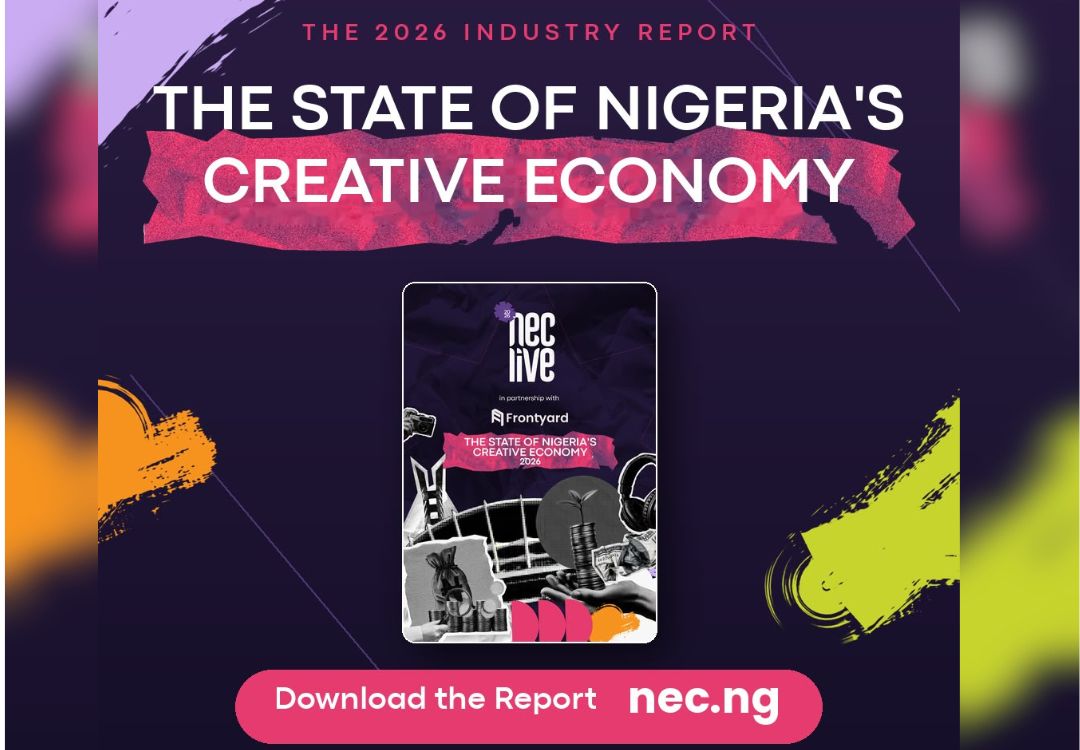
Nigeria's creative industry is not limited by a lack of talent. Instead, weak systems are holding it back from becoming a strong economic force worldwide.
This is from a new report shared on Tuesday by the Nigerian Entertainment Conference (NECLive) along with Frontyard Group.
The report, The State of Nigeria’s Creative Economy 2026, looks at the experiences of 377 creative professionals across eight industry sectors. It gives a detailed look at the problems facing one of Nigeria’s fastest-growing economic sectors. Rather than celebrating the industry’s global gains, the report focuses on the systems around creative work and spots the gaps that stop businesses from growing sustainably.
The report says that while Nigeria’s creative sector is gaining international recognition, the support systems are not keeping up. It claims that the challenge now is not creativity but creating a business environment that can sustain and make money from that creativity.
Weak Systems, Not Talent
The main finding of the report is that Nigeria’s creative economy suffers from weak systems rather than a shortage of talent.
Respondents pointed out unreliable infrastructure, administrative issues, payment problems, lack of financing, and gaps in professional training as the main barriers to productivity and long-term growth.
Among the key findings, 83 percent of people said they lose over 10 percent of their productive workweek to non-creative tasks like logistics, contract management, and chasing payments. More than half (53.6 percent) said they lose at least a quarter of their workweek to these tasks. Nineteen point six percent reported that administrative work takes more time than their actual creative work.
The report calls this “administration tax.” It shows the lack of efficient financial systems and legal frameworks that let creatives focus on making content instead of handling routine issues. It claims that recovering just half of the time lost to admin work could boost productivity without needing more money.
Power supply and internet issues are also the biggest daily challenges for the industry. These problems rank higher than funding delays, regulatory issues, and intellectual property theft. The report explains that unreliable electricity and internet continue to disrupt creative work and limit business growth.
Key Findings
The report also highlights issues that affect teamwork and business growth in the industry.


According to the survey, 52 percent of respondents named poor project briefing as a major problem in teamwork. In comparison, 51 percent mentioned payment disputes, showing that weak business practices hurt trust and efficiency in the creative ecosystem.
Also, access to funding and distribution remains the biggest gap in the industry, more than infrastructure and intellectual property tools. This highlights the need for better commercial support systems to help creative businesses grow.
The report points out that challenges exist outside Nigeria too. It found that 57 percent of barriers to exports come from payment processing and foreign exchange issues. This means financial infrastructure is a bigger hurdle to international growth than the quality of Nigerian creative products. Many creatives struggle to get paid by clients abroad, even with rising global demand for Nigerian content.
From Influence to Industry
Tomiwo Ojo, Head of Content at ID Africa, spoke about the report. He said its findings change the discussion from celebrating Nigeria’s cultural influence to fixing the structural issues that limit its economic impact.
“We have never lacked influence. What we have lacked is evidence about the machinery beneath that influence and the honest conversation that evidence makes possible. A sector that can name its own constraints is a sector ready to be built. The talent has already done its part. It is time for the systems to catch up,” he said.
The organisers say the report aims to give the government, investors, and private-sector stakeholders insights into the changes needed to unlock the sector’s full economic potential.
Recommendations
Beyond spotting the industry’s challenges, the report suggests reforms to strengthen Nigeria’s creative economy.
It calls for investments in reliable power and internet, better cross-border payment systems, and easier access to affordable financing for creative businesses. The report also suggests reducing administrative burdens through better business support services, more industry-focused training programs, and stronger teamwork among government, investors, and private-sector players to tackle long-standing gaps.
The report believes that fixing these systemic issues would let creative professionals spend more time on innovation and content creation. This will help Nigerian creative businesses compete better in international markets. Instead of just finding new talent, it stresses that building efficient commercial systems is crucial for unlocking the sector’s long-term economic potential.




Drop your comment
No comments yet — be the first to drop the gist 👇